David Collins walks through the full framework — the Yellow Button failure modes, the Blue Button protocol, and why clarity is the only ethical foundation for executive recovery.
Use arrows or dots to navigate
Slides not available in this preview. They will load correctly when the page is live at petes.mauniuact.com.
⬇ Download PDF instead"Take a really clever person who believes in themselves… what do you get? Somebody who thinks they don't have to play by the ordinary rules."
High-performing professionals maintain a successful façade while experiencing internal chaos. The same tenacity that drives top-tier commercial output renders them impervious to standard help. Their self-belief is both their greatest asset — and the primary barrier to honest recovery.
This is Pete's story. And it is far from uncommon at your level.
High-functioning professionals experience a specific psychological profile that makes standard corporate mental health pathways actively counterproductive. Understanding this profile is the starting point for any effective intervention.
High-performing individuals believe ordinary rules and physical limits do not apply to them. The same cognitive architecture that drives commercial excellence erects walls against conventional support.
Professionals maintain an image of success while their private lives experience extreme volatility. The performance of competence becomes indistinguishable from the mask itself.
Relying on brute-force resilience to manage addiction eventually leads to total performance collapse. The strategy that built the career becomes the mechanism of its destruction.
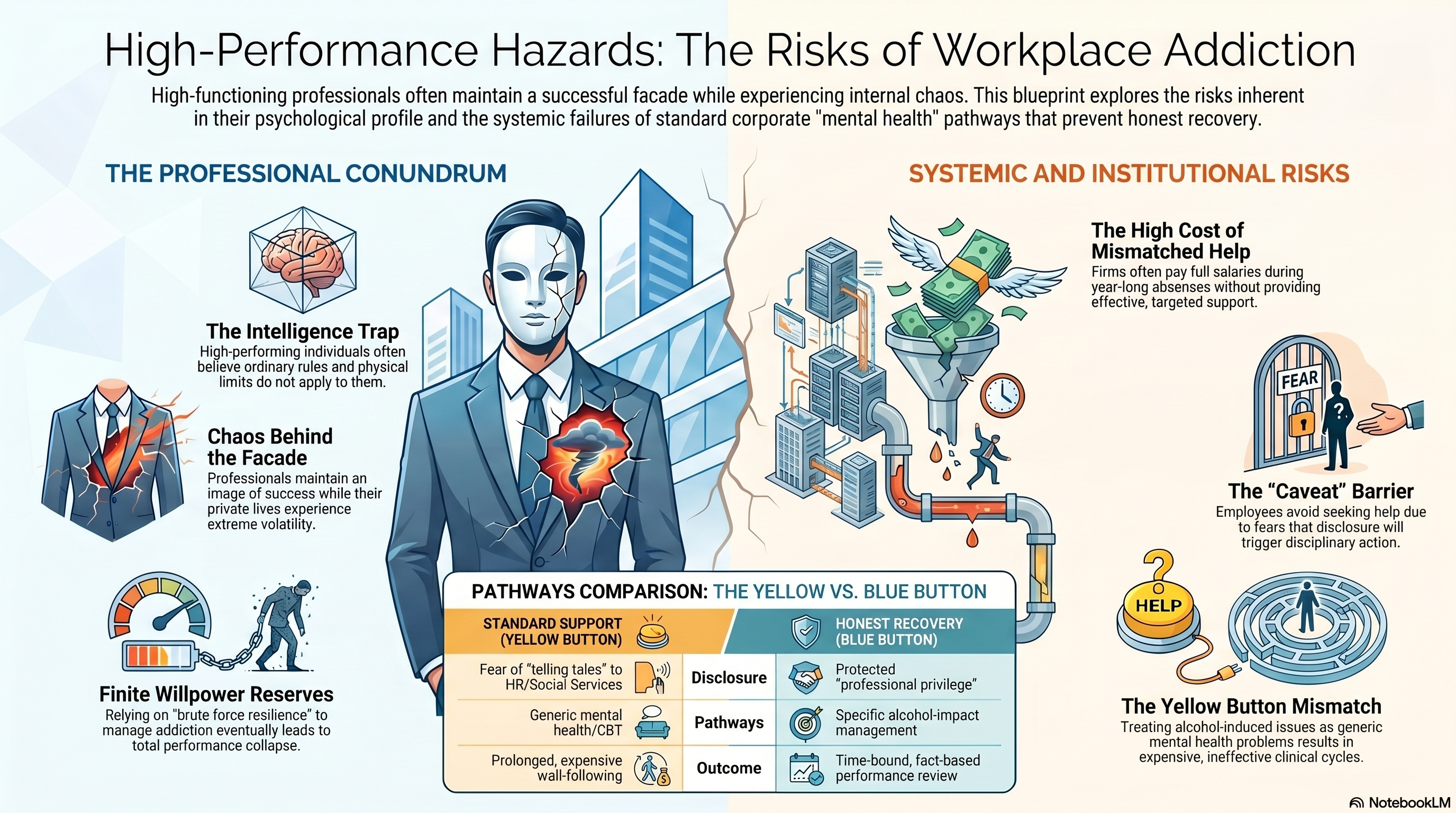
© David Collins / MAUNi · High-Performance Hazards: The Risks of Workplace Addiction
Standard corporate support pathways create three compounding failure modes that guarantee non-engagement from the very executives who need help most.
Forcing an alcohol or substance issue down an adjacent mental health pathway treats symptoms like anxiety, but ignores the primary driver. You cannot solve an addiction with a generic CBT referral.
High-profile executives reject internal help because it arrives laden with hidden caveats and professional risks. HR support is perceived as risk management for the firm — not protection for the individual.
Without true professional privilege, disclosure is experienced as weaponisable vulnerability. The "Caveat Barrier" means employees avoid seeking help rather than risk triggering disciplinary action.
"We will only help you if we reserve the right to screw you." — That is how it reads to the executive who needs honest recovery.
The workplace passes the problem amongst itself, hostage to secrecy and shame, whilst paying a premium for zero commercial return.
The choice is structural, not stylistic. One pathway guarantees ambiguity and cost. The other delivers truth, accountability, and commercial resilience.
| ⚡ The Yellow Button | ◉ The Blue Button | |
|---|---|---|
| Approach | Nebulous mental health support | Targeted addiction recovery |
| The Rule | Hidden caveats & threats | Clear facts & unconditional boundaries |
| Mechanism | Passive medical engagement | Active accountability sprints |
| Disclosure | Fear of "telling tales" to HR | Protected professional privilege |
| Outcome | Highly paid absenteeism | Re-engaged commercial resilience |
The Blue Button Protocol is a structured, time-bound engagement — not an open-ended wellness programme. Every step is definitive. Every outcome is measurable.
Direct, fact-based confrontation. A 90-minute session that strips away the façade — not to wound, but to locate solid ground for what follows.
Strict commercial boundaries with clear employment stakes. The executive is given a challenge worthy of their capability — not a passive suggestion.
Active, professionalised support keeping the executive accountable during withdrawal. Recovery Coach available. The space is held — never abandoned.
Definitive, time-bound assessment of progress and compliance. Facts replace conjecture. Performance metrics replace speculation about wellbeing.
Structured return to high-performance output — weaponising new adaptability. The executive returns stronger than they left. The organisation gains what the addiction was costing it.
High-performers require a challenge to solve. Generic wellness pathways fail precisely because they offer comfort rather than contest. The benefit lies in persevering through friction — not in the destination.
Clarity is the therapeutic instrument, not its absence. Executives process difficult facts better than vague support. Ambiguity creates fear; stark reality creates focus.
"If you know you're used to dealing with challenges, rejection, and judgment… it's not frightening. It's the unknown that's frightening."
© David Collins — The Blue Button Framework
Executives process difficult facts better than vague support. Ambiguity creates fear; stark reality creates focus.
Define the stakes immediately. "You do not engage with clients for 6 months. Your job is on the line. Prove your performance." This is not punishment. This is the structure that makes recovery possible.
High-performers require a challenge worthy of their drive. The Blue Button Protocol is that challenge — structured, time-bound, and genuinely difficult.
The tools required to survive addiction are exactly the same tools required to lead an organisation through extreme adversity. David Collins does not offer therapy. He offers a structured transfer of the most battle-tested resilience methodology available.
Collins Window © | CPRC © | 4Q Model ©
© 2026 David Collins Coaching — All rights reserved
You are igniting organisational transformation. The return on a structured Blue Button intervention extends far beyond the individual.
Replacing nebulous, year-long paid absences with structured, highly accountable 6-week performance sprints. The intervention costs a fraction of a single month of full-salary absence.
Neutralising the threat of unpredictable executive behaviour impacting high-value client relationships and firm credibility. The risk is quantifiable. The Blue Button makes it manageable.
Retaining uniquely brilliant individuals who possess the rare drive to overcome friction — then leveraging their recovery to upskill the entire team's resilience architecture.
You are not just saving a career — you are igniting organisational transformation.
The tools required to survive addiction are exactly the same tools required to lead an organisation through extreme adversity. Professionalism — not just sobriety — is the foundation of sustainable recovery.
The complete Blue Button Framework — 10 slides covering the Blueprint of a Brilliant Liability, the Status Quo analysis, the paradigm shift, the Protocol, and the Commercial Reality. © David Collins / MAUNi.
10 slides · 8.5 MB